

Unicoorn CV Builder: helping fresh graduates find the proof they already have
Overview
In October 2026, Unicoorn, a career-readiness platform for Indonesian students and fresh graduates, ran a one-week design challenge. The brief was narrow on purpose: don't design the whole CV builder, only how the product helps users decide on and shape the content of their CV. It also left two things undefined: what an ideal CV looks like, and what form the solution should take.
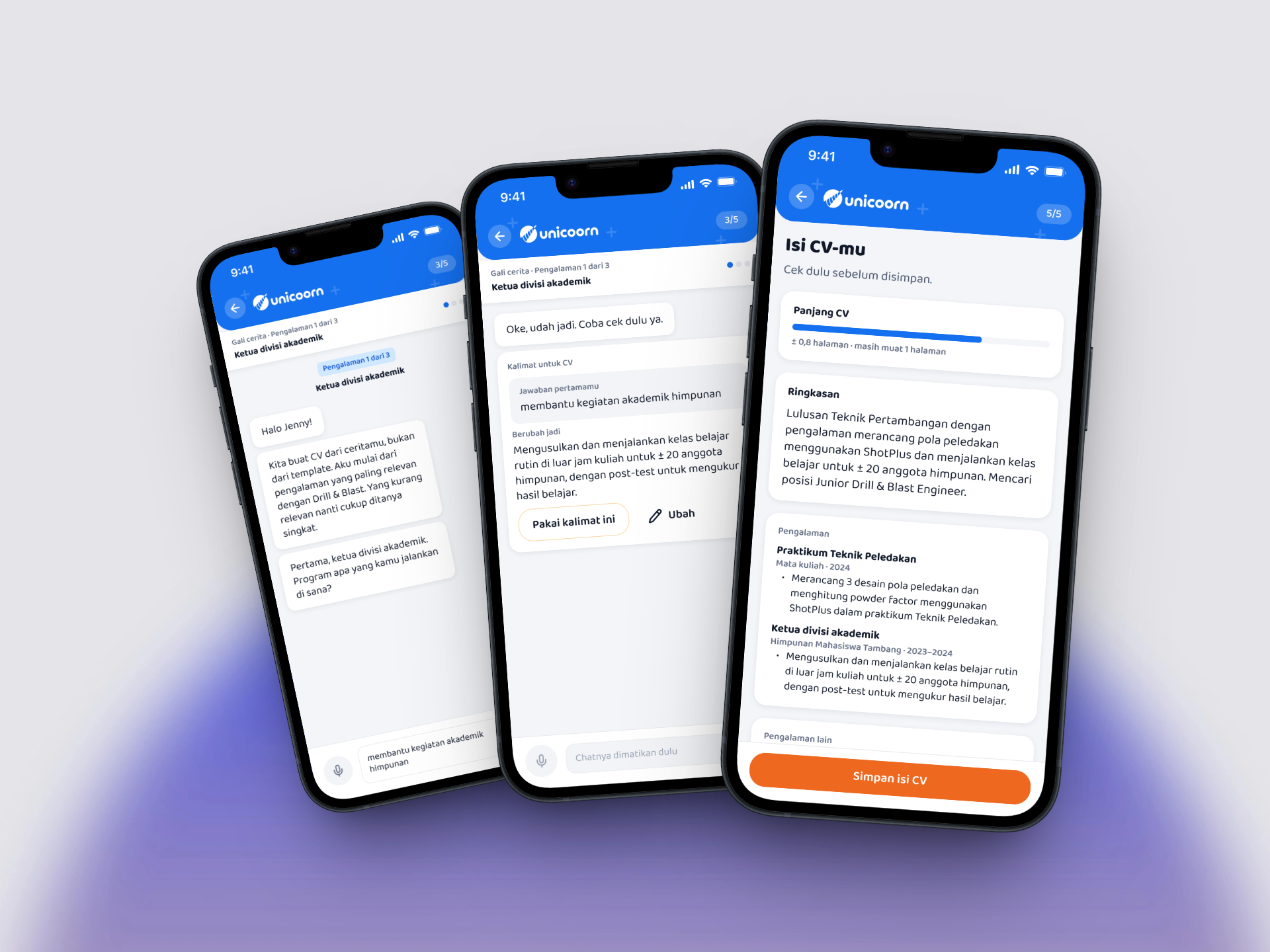
I designed a guided coach that asks about your experience before it writes anything, and turns your answers into CV lines you can edit.
- My role: solo, covering research, synthesis, UX and UI design, prototyping and writing
- Timeline: one week, 26–30 October 2026
- Tools: Google Forms, video calls, Figma, and Claude for analysis support
This is a concept from a design challenge, not an official Unicoorn product. Unicoorn's brand, logo and mascot belong to Unicoorn. This version goes further than my original submission, building on mentor feedback I received after the challenge.
The problem
I went in thinking the hard part of a CV was making it look good. My own survey of 41 students and fresh graduates disagreed: only 3 of them struggled with layout. Most were stuck on what to write and how to say it.
That matters because the CV is the first gate. Recruiters skim it in about 7.4 seconds on the first pass (Ladders, 2018), and employers want to see examples of skills, not lists of them (NACE, 2026). A CV full of duties can get skipped before anyone meets the person behind it.
And the group facing this is big. Indonesia had 1,033,737 unemployed university graduates in February 2026, up from 1,010,652 a year earlier (BPS via Project Multatuli). For Unicoorn, a platform built around practice and proof, the CV is where that proof finally reaches an employer, so getting it right is close to the core of what Unicoorn offers. And since 83.39% of Indonesian internet users go online mainly by smartphone (APJII 2025), it had to work on a phone first.
How I did the research
Everything in this section is my own primary research, except the desk research, which I label with its source.
| Method | Who and when | What I got |
|---|---|---|
| Survey (Google Form) | 41 respondents, October 2026: 17 final-year students, 21 graduated less than a year ago, 3 graduated 1–2 years ago | How they build their CV, where they get stuck, what they leave out, how confident they feel, and how many callbacks they've had |
| Interviews (live video calls) | 3 fresh graduates, 27–28 October 2026: P1 and P2 from mining engineering, P3 from civil engineering | The story behind their CV, in their own words. P1 and P2 also walked me through their actual CVs; P3 preferred not to share hers |
| CV review | P1's and P2's real CVs | A side-by-side of what they told me versus what they wrote |
| Desk research | CV guides, recruiter studies, Indonesian labour data, existing CV tools | A reference for a "good CV" and the market context, cited where used |
I ran every interview myself, live, with a script I prepared in advance. Claude helped me tabulate the survey and summarise the transcripts afterwards; it didn't take part in, or simulate, any interview. Participants' names are replaced with codes (P1–P3) to protect their privacy.
What this research can't tell me. The sample is small, engineering-heavy (about 14 of the 41 respondents are from mining) and drawn from my own network. Only 3 of 14 survey volunteers followed through to an interview, and I opened P3's call by showing the concept, which may have shaped her answers. So I read every number here as a signal, not proof.
What I found
I wrote every survey answer and interview observation on its own note, then grouped them until patterns appeared. Four did:
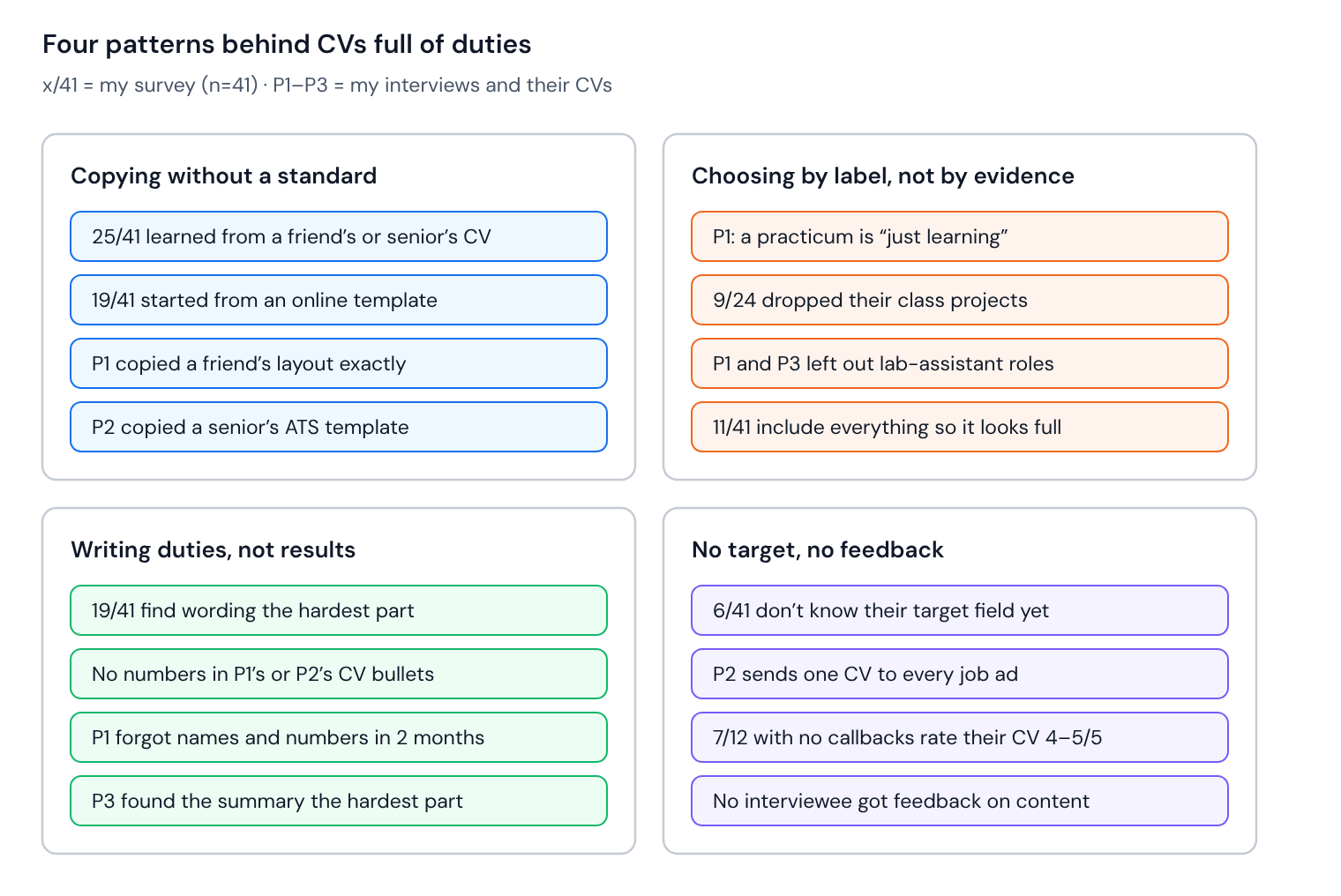
Copying without a standard. Nobody had a reference for what a good CV line looks like, so people copied the nearest example: a friend's, a senior's, a template's. The duty-style phrasing came along with the layout.
Choosing by label, not by evidence. People judged experience by its title, not by what it proved. When I asked P1 why her blasting practicum wasn't on her CV, given that she was applying for Drill & Blast roles, she said it was "masuk ke pembelajaran", just part of studying, so it didn't feel like a skill. Others went the opposite way and included everything, afraid the CV would look empty.
Writing duties, not results. Wording was the hardest part in the survey, and neither real CV had a single number describing a result. Yet when I asked P1 one follow-up question ("Berapa orang yang ikut?"), she immediately remembered about 20 students and the post-tests she used as evidence. The detail was there; nobody had asked for it. Two months after graduating, she'd already forgotten the programme names.
No target, no feedback. Some didn't have a target role yet, and P2 sent the same CV to every job ad. Rejections came without reasons, so people were left guessing, and many rated their CV highly despite getting no callbacks.
Counter-evidence worth keeping. Not everyone fits the pattern. P3 already keeps a different CV for each application, and 27 survey respondents said they pick experience that fits the role. But even P3 left out her lab-assistant roles, and her hardest part was the summary. So the gap isn't only choosing what to include; it's also turning experience into words.
One thing I got wrong at first. From the survey alone, 24 of 39 sample CV lines were just role titles, so I assumed people barely write anything. Then I saw the real CVs: full bullet points, just written as passive duties. The real gap is duties → evidence, not title → nothing.
Their journey today
To see where these patterns hurt, I mapped the journey my interviewees actually went through, from the moment they needed a CV to the silence after applying.
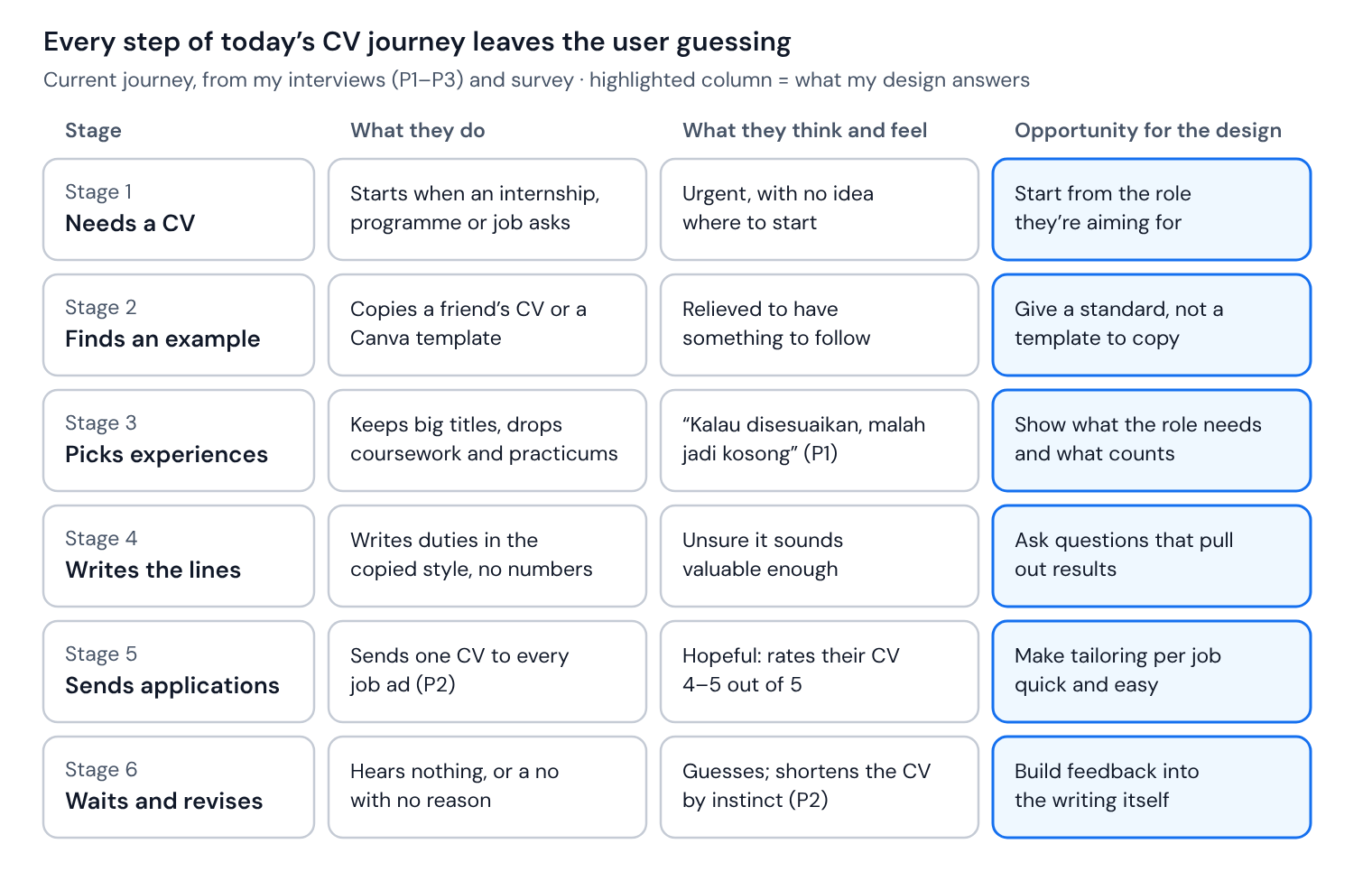
Two things stood out. First, the problems compound: a copied template (stage 2) leads to duty-style lines (stage 4), which lead to a rejection nobody explains (stage 6). Second, nothing in the journey ever asks the person a question. Every step is something they do alone, guessing. The only moment their real stories came out was when I asked during the interview.
From research to design direction
This is where the research turns into decisions. Each pattern from the affinity diagram, and each opportunity from the journey, became one direction for the design:
| Pattern I found | So the design should… | Which became… |
|---|---|---|
| Copying without a standard | Teach a standard instead of handing over a template | A coach that shows what a strong line contains: what you did, for how many, and what changed |
| Choosing by label, not by evidence | Judge experience by what the target role needs, not by its title | A target role chosen first, with its requirements visible; coursework and lab work named as real experience |
| Writing duties, not results | Ask for results instead of waiting for them to be written | Short guided questions for each experience, accepting estimates like "± 20" |
| No target, no feedback | Give feedback while writing, and make tailoring cheap | A reaction to every answer, a check for what the role still needs, and saved stories reusable for the next job |
My hypothesis. If fresh graduates are asked targeted questions about each experience, and can see what their target role needs before they write, then their CV lines will include concrete results and relevant evidence, because the details already exist in their memory but are never prompted (pattern 3), and relevance is currently judged by label rather than by fit (pattern 2).
The P1 interview was my first evidence: one question, "Berapa orang yang ikut?", turned a generic line into a specific programme. A study of 3,400 students at the University of Waterloo points the same way: exposure to the STAR format was the only significant factor in how well students described their skills (Tomasson Goodwin et al., 2019).
How I'd know it works. These are the measures I'd use to test the hypothesis, with a baseline where I have one:
| Measure | Why it matters | Baseline from my research |
|---|---|---|
| Share of CV lines that include a number or a result | The core promise: duties become evidence | 0 result numbers in the 2 real CVs I reviewed |
| Share of users who finish digging at least one experience | Whether the chat is worth the effort | None yet |
| Number of tailored CV versions per user | Whether tailoring became cheap | P1 and P2 used one CV for every application |
| Users who return to Unicoorn's practice features within 30 days | The business link (below) | None yet |
Why it matters to Unicoorn's business. My working theory, to be tested with the measures above: the CV builder can be Unicoorn's way in, its main source of new users. People need a CV early: 17 of my 41 respondents were still students, and P2 needed one in her sixth semester for an internship. A CV coach brings them in before graduation (acquisition). Finishing their first CV content gives them a first win (activation). And because their stories are saved, they come back to tailor for each new job, and the same stories feed interview practice, which uses the same "what you did, what changed" structure (retention). Each finished CV line is also proof of the practice-and-proof promise Unicoorn is built on.
What a good CV line looks like
The brief didn't define a good CV, so I had to pick my own yardstick. Mine is simple: a good CV line says what you did, the measurable result, and how you did it, and it's relevant to the job you're applying for. I built that from three sources:
| Source | What I took from it | Why I trust it |
|---|---|---|
| Laszlo Bock, "My Personal Formula for a Winning Resume" (2014) | The XYZ structure: accomplished X, measured by Y, by doing Z | Written by Google's then-SVP of People Operations. A primary source, though a personal post, not official Google policy |
| Harvard Guide to Creating a Strong Resume | Start with an action verb, and quantify where you can | An institutional career office, widely used as a baseline |
| ECC UGM CV workshop notes | Local norms: 1–2 pages; practicums and lab-assistant roles count as experience if relevant; personalise for each job | One of Indonesia's best-known university career centres, adapting Western advice to local hiring |
ECC UGM mattered most to me, because it confirms that the experience my participants undervalued, practicums and lab-assistant roles, genuinely counts in Indonesia.
Here's that standard applied to P1's real CV line, using only facts she told me in the interview:
Before (her CV): Menyelenggarakan sesi pembelajaran rutin di luar jadwal kuliah untuk memberikan dukungan kepada anggota himpunan. After: Mengusulkan dan menjalankan kelas belajar rutin di luar jam kuliah untuk ± 20 anggota himpunan, dengan post-test untuk mengukur hasil belajar.
The "after" line has all three parts: what she did (proposed and ran a study class), for how many (about 20 members), and the proof (post-tests).
Ideas I explored, and what I chose
The brief left the form of the solution open, so I compared six directions against the four patterns. Each had something worth keeping, even the ones I rejected:
| Direction | Why it doesn't solve my problem | What I kept from it |
|---|---|---|
| Template builder (e.g. Canva) | It fixes layout, which only 3 of 41 struggled with, and it encourages copying placeholder text: pattern 1 again | Nothing; the brief leaves templates out of scope |
| AI generator (e.g. Rezi, Kickresume) | It writes from a job title, not from the user's facts, so the lines stay generic, and recruiters reject generic content | AI that polishes the user's own facts, never invents them |
| CV scorer (e.g. Dealls, KitaLulus) | It grades a finished CV but can't help you find what's missing | Feedback, but given while writing instead of after |
| Pure chatbot (e.g. ChatGPT) | Great at asking, but slow for listing, sorting and editing on a phone | The chat itself, used only for asking |
| Form wizard, one field per screen | Still a blank box per field, and it can't follow up when an answer is vague | One question at a time |
| Full gamification (XP, streaks) | Points would reward inflated answers, and streaks add pressure to an already stressful task | The feel: progress you can see, and a coach that responds to each answer |
So I chose a guided coach that works in two modes: chat for asking, cards for deciding. The chat pulls out the stories one question at a time, the way my interviews did. The cards let users choose and edit what goes into the CV, because sorting and editing are faster to tap than to type.
From first draft to final
The final flow didn't arrive in one go. I prototyped early, clicked through it, and changed whatever didn't hold up. These are the turns that shaped it:
| Draft | What went wrong | What I changed |
|---|---|---|
| 1. Questions on many screens | Reminders lived on the inventory screen and a number check on the preview, so the product asked questions in four different places | Moved every question into one chat. The principle: the coach asks in one place; the user decides on cards |
| 2. A chat room per experience | A reminder about blasting experience popped up inside the lab-assistant topic, where it made no sense | One continuous chat with a divider per experience, and the reminder in its own closing check at the end |
| 3. Requirements in a separate sheet | An extra screen just to read what a role needs | The requirements now open inside the role card itself, so roles are easy to compare |
| 4. Merging similar entries after digging | Jenny accepted a sentence about one lab role, then a merged sentence silently replaced it | The coach asks whether similar roles are the same before digging; the chat dropped from 5 experiences to 3 |
| 5. Scores and mascot reactions on every sentence | A strength meter and celebrations made the screens busier, and added AI judgment outside the chat | Dropped them. Feedback now comes as the coach's own words, and AI stays inside the chat |
Here's the flow those changes led to:
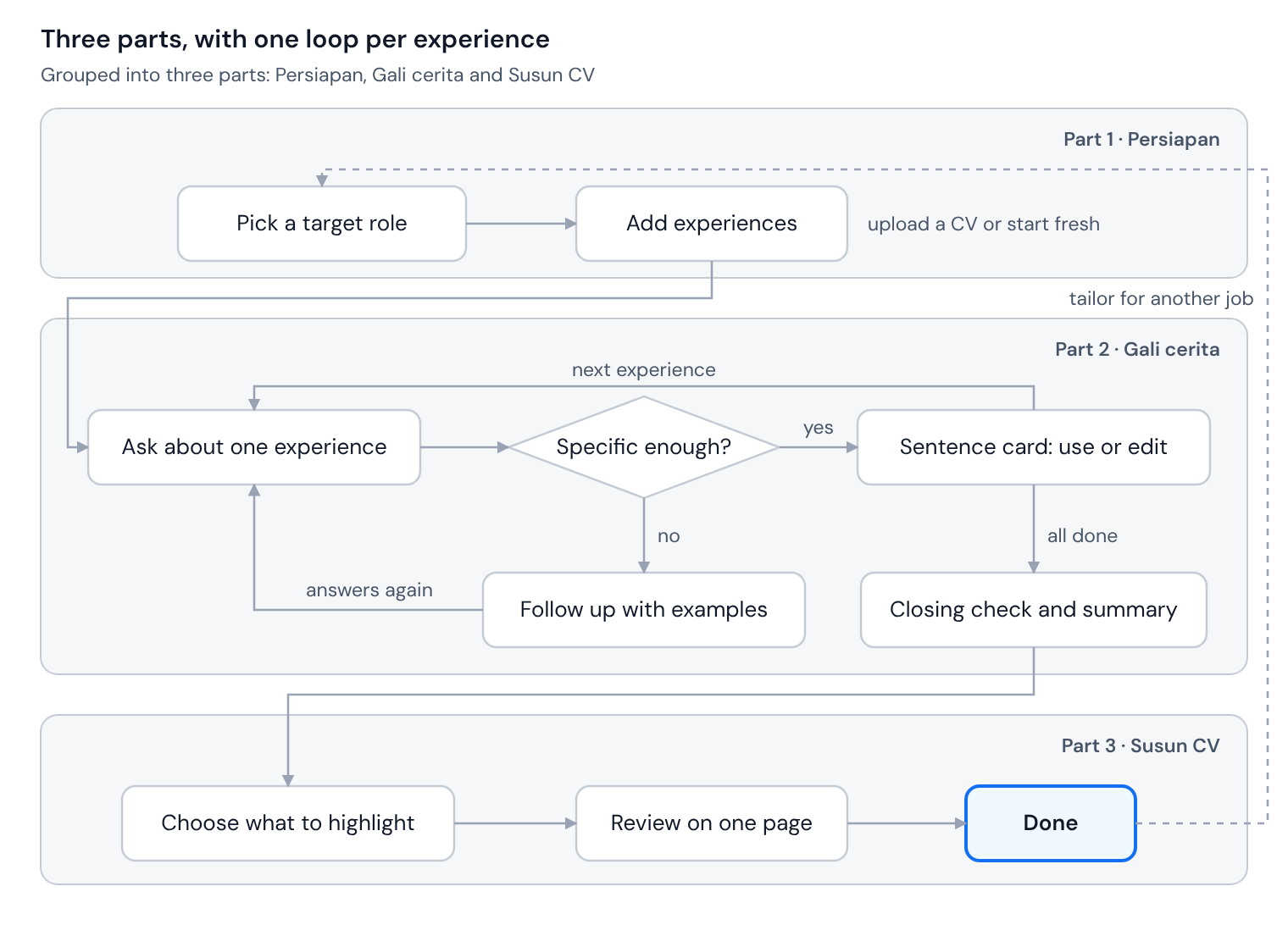
The flow falls into three parts: Persiapan (preparation), Gali cerita (digging the stories) and Susun CV (putting the CV together). Inside part 2, each experience runs through the same small loop until it becomes a sentence the user accepts.
How it works
Here's the experience from the user's side. Jenny, a fictional fresh graduate whose story is based on P1's, wants to become a Junior Drill & Blast Engineer.
Part 1 · Persiapan. Jenny picks a target role, suggested from the major in her profile. Selecting it opens up what similar job postings ask for. Then she uploads her existing CV, which fills her list of experiences (only role, place and dates come across; the old wording stays behind), or she adds them by hand.
Part 2 · Gali cerita. One chat goes through her experiences, most relevant first. For each one, the coach asks what she did, for how many people, and what changed; she picks an example answer or types her own. When an answer is too vague, the coach says so and offers starting points. Each experience ends with a sentence card she can use or edit. If she has several similar roles, the coach first asks whether they're the same, and digs them once, as one. A closing check asks about anything the role needs that her stories didn't cover, and the last card is her summary.
Part 3 · Susun CV. She sorts her experiences into tonjolkan (highlight), cantumkan saja (just list) and simpan dulu (save for later), each with a short reason tied to the role. Then she reviews everything against a one-page budget.
Decisions I made, and what they cost me
| Decision | Why | What I gave up |
|---|---|---|
| Ask before writing | P1's details only came out when asked, and the STAR study backs this up | It's slower than generating a CV in one tap |
| One chat for every question, every reply in a bubble | One place, one voice. The error state lives in the coach's own words ("Hmm, ini masih terlalu umum") | A long chat needs dividers and a clear progress indicator |
| AI writes only in the chat, and only from the user's facts | Recruiters penalise generic AI text, and every other screen runs on fixed copy and templates, which is cheaper and more predictable to build | Less magic than competitors, and other screens can't tailor their wording |
| Target role first, with requirements in the role card | P2's K3 certificate stayed buried, and P2 and P3 both first applied off-target | Users without a target need a "Belum tahu" path |
| Dig the most relevant experience first, and accept estimates like "± 20" | Long chats lose people, and P1 had forgotten exact numbers two months after graduating | Weaker items get a lighter dig, and estimates stay marked "±" |
| An existing CV fills the list, not the content; similar entries are settled before digging | P1's CV wording drifted from what she described, and repeated itself | Users answer every question anyway, plus one extra question per group of similar entries |
| Three tiers instead of include/exclude | "Takut kosong" made P1 and P2 include everything; P3 already tailors, and the tiers make that choice explicit | One more step |
| Write the summary last, in the chat | P3's hardest part was the self-description | Anyone who wants to write it themselves has to edit it |
Edge cases, and what happens
| Situation | What the user sees |
|---|---|
| Her answer is too vague | The coach explains why and offers example answers to start from (the error state) |
| She doesn't know her target role yet | "Belum tahu" suggests roles from her major |
| She has nothing to upload | The empty state lets her add experiences by hand, naming practicums and lab work as valid |
| She can't remember an exact number | Estimates like "± 20" are offered as answers |
| Her stories don't cover something the role needs | The closing check asks about it; "Nggak pernah" is a fine answer |
| The sentence can't be generated (no connection) | Her answers are saved, with a single "Coba lagi" (try again) |
| She disagrees with a sentence | "Ubah" lets her rewrite it before it's used |
| She taps back in the middle of the chat | Planned: a sheet confirming her stories are saved, so she can leave and pick up later (see What's next) |
Where it would be hard to build. Only the chat needs AI; everything else runs on fixed copy, templates with data, a role catalog and simple logic. The role requirements need a list per role, so a launch could start with the most common roles, and a pasted job ad can supply requirements directly. Similar entries are never merged silently; the coach asks. And uploaded CVs only need their structure read, so parsing mistakes are easy to fix in the list.
The screens
The UI is in Indonesian, as Unicoorn's brand guide requires, so I've translated the key lines below. Every screen is built from Unicoorn's starter kit, plus three new components: the sticky topic bar, the sentence card and the page-length bar.
| # | Screen | Image | What's going on |
|---|---|---|---|
| 1 | Pick a target role | [Image: role list with Junior Drill & Blast selected and expanded] | Roles are suggested from the major in Jenny's profile, and the screen says so. Selecting one shows what similar postings ask for, using the same chips that later explain the sorting step. |
| 2 | Experiences, empty state | [Image: empty inventory with the upload card and the mascot] | Upload an existing CV or start from scratch. The empty state names practicums and lab-assistant roles as real experience. |
| 3 | The chat | [Image: first question with the sticky topic bar] | One chat for every experience, most relevant first. The topic bar shows "Pengalaman 1 dari 3" (experience 1 of 3). |
| 4 | Vague answer (error state) | [Image: vague answer, coach reply and example options] | "Hmm, ini masih terlalu umum" (hmm, that's still too general). The coach explains why and offers example answers instead of rejecting hers. |
| 5 | Writing the sentence (loading state) | [Image: coach line and typing indicator] | "Sip, bentar ya, lagi nyusun kalimat dari jawabanmu…" (got it, one moment, I'm writing the sentence from your answers), then a typing indicator. |
| 6 | The sentence card | [Image: sentence card with the old CV line and the new one] | Her uploaded CV's line as "before", the new sentence underneath, then Pakai (use) or Ubah (edit). |
| 7 | Choosing what to highlight | [Image: three tiers with the merged lab-assistant entry] | Three tiers, each item with a short reason: "Cocok dengan yang dicari" (matches what they're looking for) plus the role's requirement chips. |
| 8 | CV preview | [Image: page-length bar, summary and experience list] | Just a review, with no AI: every sentence and the summary came from the chat. The summary's three parts are marked and editable. |
| 9 | Done | [Image: graduation mascot and counts] | 4 stories dug, 3 in the CV, 1 saved for later. One main action: tailor the CV for another job. |
The prototype and design files aren't shared publicly, since they use Unicoorn's brand assets.
What's next
After the challenge, mentors reviewed every submission and shared detailed feedback. It pushed me to go further, and this version already includes much of it: the affinity diagram, the user journey, the bridge from research to design direction, clearer labels on my own data, and how I'd measure success.
A few design improvements are still on my list:
- A three-part progress stepper. The current "3/5" step counter says little in a flow this long. A stepper for Persiapan, Gali cerita and Susun CV would match how the flow actually feels.
- A "continue later" sheet. If the user taps back mid-chat: "Mau lanjut nanti? Ceritamu sudah tersimpan." (Continue later? Your stories are saved.)
- Stronger contrast on the experiences screen.
- A usability test with P1–P3, comparing their CV lines before and after.
Reflection
- Show the thinking, not just the data. My biggest lesson from the mentors. A table of findings proves I did research; an affinity diagram and a journey prove I understood it.
- Interview first, then survey. The survey's self-reported answers understated what people actually write. Talking to people first would have given me sharper survey questions.
- Ask before showing. Opening P3's call with the concept may have shaped her answers. Next time, the concept comes at the end.
- Test with the same people. The next step would be to run the prototype with P1–P3 and compare their CV lines before and after, starting with the first measure: how many lines now include a result.
How I used AI
I used Claude to tabulate the survey, summarise the interview transcripts and support desk research. I ran the interviews and designed every screen myself. Every figure was checked against its original source before I cited it.
It wasn't always right. From the survey alone, it concluded that most people write only role titles on their CVs. The real CVs showed full bullet points, just written as passive duties, which shifted my focus from helping people write more to asking them for results.
My role
A solo project: research, synthesis, UX and UI design, prototyping and writing. Unicoorn's starter kit supplied the logo, mascot and core UI components. I recruited participants through my own network, and no templates or previous projects were reused.
The result
This design won the Unicoorn Design Challenge 2026. The mentors described it as clear, well-sourced research with a brand-consistent UI and micro-interactions that bring it to life, and it received full marks for communication and storytelling.
More than the win, the feedback is what I value most: it showed me exactly where to grow next as a product designer.
Sources
- Project Multatuli: unemployed graduates, BPS data
- APJII 2025 via Bisnis.com: smartphone as main device
- HR Dive: Ladders eye-tracking study, 2018
- NACE: high-impact skills on resumes, 2026
- Laszlo Bock: My Personal Formula for a Winning Resume
- Harvard: Guide to Creating a Strong Resume
- ECC UGM: Seriuslah dalam membuat CV
- Tomasson Goodwin et al. (2019), Education + Training
About the author
- I'm Akbar, a UI/UX and product designer with 5 years across healthcare, education, and tourism products. I build multi-brand design systems in Figma and ship websites in Astro.
Comments
Join the discussionNo comments yet. Be the first to comment.
Case Study
In this series, I will share my comprehensive case study, detailing my design process for you to explore.


